OFFICIAL NOTICE CITIES OF EASTVALE, FONTANA, JURUPA VALLEY, AND ONTARIO IN RIVERSIDE AND SAN BERNARDINO COUNTIES PLEASE READ IMMEDIATELY
Between September 9, 2026, and September 15, 2026, the California Department of Food and Agriculture (CDFA) confirmed that three oriental fruit flies (OFFs), Bactrocera dorsalis (Hendel) group, were trapped in the city of Jurupa Valley in Riverside County. Based on these detections, pest biology, information from the CDFA Bactrocera Science Advisory Panel (BacSAP), recommendations provided by the CDFA Primary State Entomologist, and the CDFA’s “Action Plan for Methyl Eugenol Attracted Fruit Flies including Oriental Fruit Fly Bactrocera dorsalis (Hendel),” the CDFA concludes that an infestation of OFF exists in the area. This pest presents a significant, clear, and imminent threat to the natural environment, agriculture and economy of California. Unless emergency action is taken, there is high potential for sudden future detections in Riverside and San Bernardino counties.
In accordance with integrated pest management principles, the CDFA has evaluated possible eradication methods and determined that there are no cultural or biological methods available to eliminate OFF from this area. This Proclamation of Emergency Program is valid until April 10, 2027, which is the amount of time necessary to carry out the treatment plan across three life cycles of OFF as required by the treatment protocol for OFF. The CDFA will employ chemical control as the primary tool and will additionally use physical control via host fruit removal when there is evidence that a breeding population exists on a property.
The detections of OFF described above require immediate action to address the imminent threat to California’s natural environment, agriculture, and economy. More specifically, in addition to a wide variety of commercial crops, OFF threatens loss and damage to native wildlife, private and public property, and food supplies. Because the life cycle of the OFF detected between September 9, 2026, and September 15, 2026, has not yet transpired, there is a high potential for sudden future detections in Jurupa Valley. Therefore, the Secretary is invoking Public Resources Code Section 21080(b)(4) to carry out immediate emergency action to prevent the aforementioned loss and damage to California’s resources.
The treatment plan for the OFF infestation will be implemented as follows:
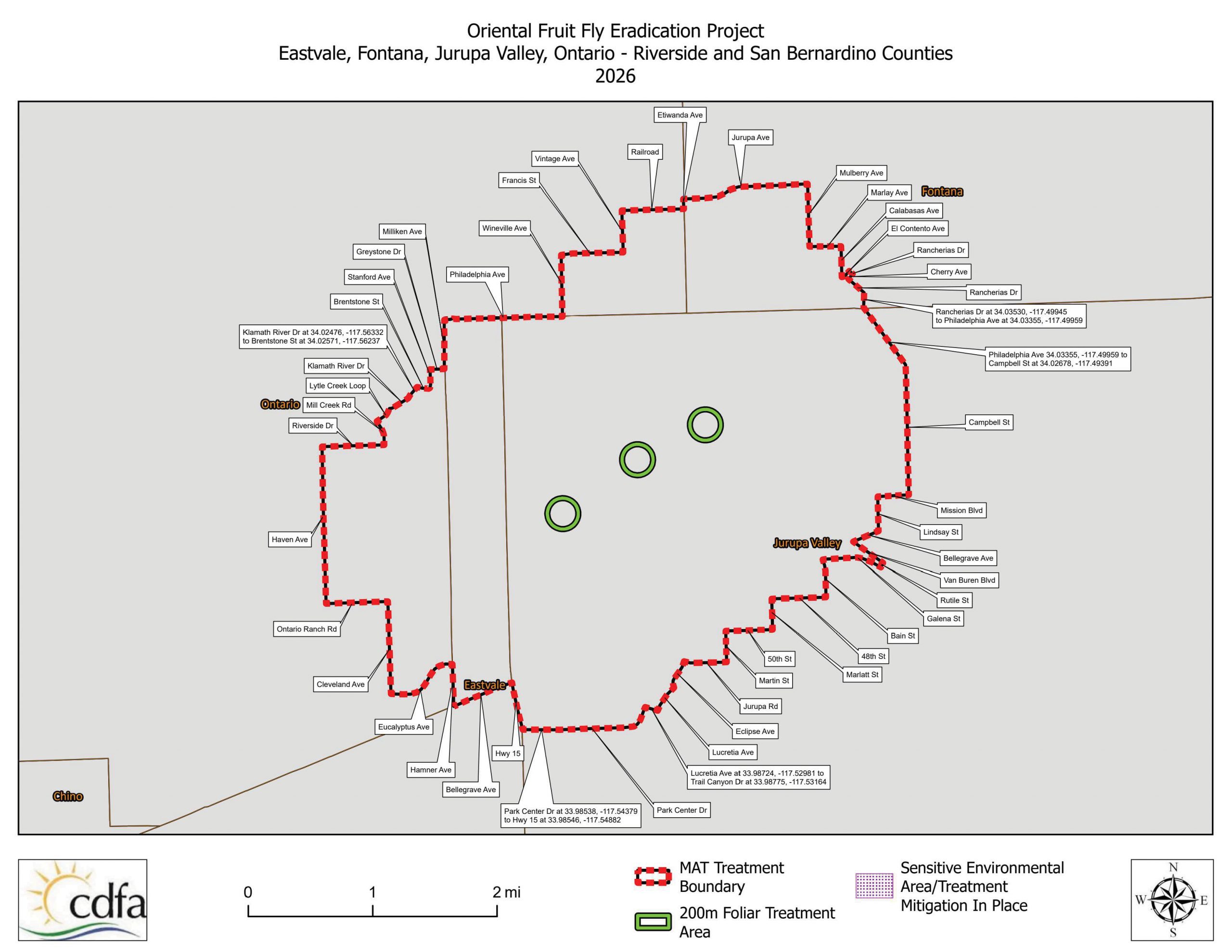
- Chemical Control: The male attractant technique (MAT) will be used to eliminate all sexually-mature male OFFs. MAT applies small bait stations using STATIC™ Spinosad ME, which is a pre-mixed solution containing the attractant methyl eugenol and an organically registered pesticide spinosad, mixed into a waxy time-release matrix (SPLAT®). The methyl eugenol lures male flies to the bait stations, where the flies ingest the insecticide as they feed. The flies are killed when they feed at the stations. In each square mile within the eradication boundary, a targeted density of 300 evenly spaced five-to ten-milliliter bait stations are applied to utility poles, street trees, and other unpainted surfaces using pressurized tree marking guns mounted on specially modified trucks. The bait stations are placed six to eight feet above the ground. The size of the eradication area is defined as that area within 1.5 miles of each detection site and adjusted to create a nine-square-mile block marked by existing features, such as roads. Applications are repeated every two weeks for one life cycle if no quarantine is triggered (typically two to three months), and for two life cycles if a quarantine is triggered (typically four to six months). Life cycle durations are dependent on temperature.
- Chemical Control: If evidence that a breeding population exists on a property (i.e., immature stages, mated female, or multiple adults are detected), foliar bait treatments may be used within 200 meters of each detection site in order to mitigate the spread of OFF by eliminating those adult life stages not directly affected by MAT (i.e., females and sexually immature males). Foliar bait ground treatments are a protein bait spray that contains an organic formulation of the pesticide spinosad (GF-120 NF Naturalyte® Fruit Fly Bait) and are repeated every seven to 14 days for one life cycle of the fly (typically two to three months, dependent on temperature). Please visit the CDFA website to learn more about the treatment process at http://www.cdfa.ca.gov/plant/videos/spinosad/.
- Physical Control: If evidence that a breeding population exists on a property (i.e., immature stages, mated female, or multiple adults), all host fruit from each detection site and all properties within a minimum of 100 meters of each detection site may be removed and disposed of in a landfill in accordance with regulatory protocols. Fruit removal will occur at the beginning of the project but may be repeated if additional flies are detected.
Public Information:
Except in circumstances where CDFA needs to execute an inspection or abatement warrant, residents whose property will be treated via foliar bait sprays or host fruit removal will be notified in writing at least 48 hours in advance of any treatment. Following the treatment, completion
notices are left with the residents detailing precautions to take and post-harvest intervals applicable to any fruit on the property.
Additional information for this invasive pest and treatment activity is posted at www.cdfa.ca.gov/plant/PDEP/treatment/oriental_ff.html. Emergency program area maps are posted at: www.cdfa.ca.gov/plant/PDEP/treatment/treatment_maps.html.
Press releases, if issued, are prepared by the CDFA information officer and the county agricultural commissioner, in close coordination with the project leader responsible for treatment. Either the county agricultural commissioner or the public information officer serves as the primary contact to the media. Information concerning the OFF project shall be conveyed directly to local and State political representatives and authorities via letters, emails, and/or faxes. For any questions related to this program, please contact the CDFA toll-free telephone number at 800-491-1899 for assistance. This telephone number is also listed on all treatment notices. Enclosed are the findings regarding the treatment plan, work plan, map of the treatment area, integrated pest management analysis of alternative treatment methods, and a pest profile.
Attached is the Proclamation of Emergency in its entirety, including the findings regarding the treatment plan, work plan, map of the treatment area, integrated pest management analysis of alternative treatment methods and a pest profile.